LLMs and AI agents have changed what’s possible. Problems that previously required human reasoning — interpreting intent, making sense of ambiguity, working with natural language — can now be solved with software.
But as teams feeling the pain of unfulfilled AI promises know only too well, technology alone doesn’t guarantee value. It’s bringing technology to bear on the right problems, and in the right way, that creates progress.
There are a lot of companies shoehorning AI into their products for marketing’s sake. They’re using AI where a deterministic solution would be the better choice for consistency and predictability. They’re defaulting to AI, even though natural language doesn’t provide the most intuitive UX for every task. Ultimately, these products aren’t adding value to the customer, which damages trust in AI and reduces appetite for experimentation.
At Gearset, LLMs have changed the problems we can solve, but they haven’t changed our philosophy for solving them. We start from the user’s Job To Be Done, search for the right solution unconstrained by what competitors do, and back it up with engineering that ships twice daily and iterates fast. This approach has helped us build products our customers love, and it’s how we’re creating genuine value with AI now.
TDX
Building AI products that actually add value
From our own experience and watching the market, we’ve noticed the pattern for companies making their customers successful with AI. There are three traits that are prerequisites for delivering real value with AI products.
1. Deep domain expertise translated into AI performance
The companies building AI products that customers actually adopt have mostly spent years understanding their market: the businesses they sell to, the personas within those organizations, the jobs those personas are trying to do, which problems are genuinely painful versus just plain annoying, and how value is created and captured.
These companies don’t just have expertise. They have valuable assets in an AI context: data models that encode domain-specific relationships, algorithms that solve specific sub-problems with precision, integrations that provide contextual information, and historical data that enables better prompting and evaluation. These assets can be exposed as tools to LLMs, providing capabilities and context that would take years to build from scratch.
2. Deliberate focus on well-defined problems
A deep understanding of the problem space goes hand in hand with a deliberate focus on that domain. Generic AI tools that can be applied broadly only offer shallow capabilities. Domain-tailored solutions built on deep expertise are designed to solve the problem in view.
Without domain tailoring, AI places heavy demands on users: vigilance, understanding the model’s limitations, knowing which problems it’s actually suited to, and which incantations are required to generate the outcome you’re after. Domain-tailored AI shifts that burden to the vendor, making value immediately accessible.
The difference shows up in time to value: generic AI initiatives have, for many companies, delivered no measurable ROI. Domain-tailored solutions create value almost immediately.
3. A product culture that obsesses over customer outcomes
AI creates an explosion of ideas. Every possible feature we could build is a solution to a problem, but not all problems are equal. Good products emerge from teams that think about opportunity cost — teams that identify which features actually create value and have the discipline to say no to everything else.
The possibilities of AI bring the product culture of companies into sharp focus. Companies that have historically shipped features because they could, or because competitors had them, will continue to struggle, regardless of the underlying technology. These teams will build AI features that may look good in demos, but fail to solve the problem in real-world scenarios.
The companies with strong product cultures — who always ask “What is the customer trying to achieve?”, “How might we best achieve that?”, and “How will we know if this works?” — will build the AI-powered solutions that customers actually use.
Gearset’s AI trajectory: what we’ve built and what we’re delivering now
Gearset has a decade’s experience working with thousands of Salesforce teams to build a product that solves their challenges. Over time, Gearset has evolved to support the complete DevOps lifecycle, helping teams deliver the right changes to production, more reliably and more frequently, so they can respond more quickly to changes in their business.
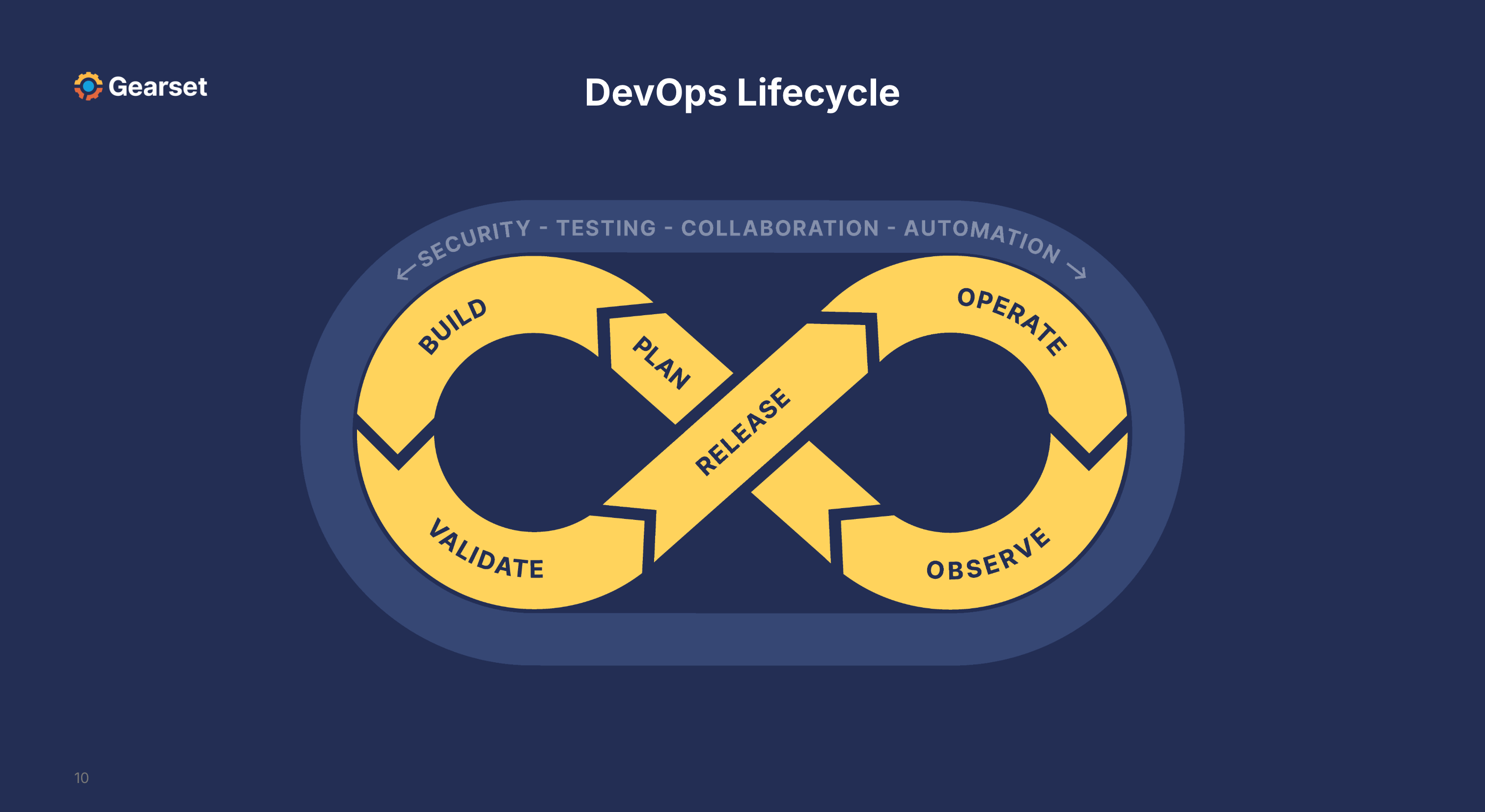
DevOps is ultimately in service of helping our customers be as agile as possible, and that larger goal remains our focus as we develop and release AI products.
We’re not rushing out shallow AI functionality across the whole platform in a uniform way. Instead, we’ve focused on specific, well-defined problem areas. The extent to which we lean on AI, and the way we use AI, depends on the job. Where problems are best solved using traditional, deterministic methods, that’s the approach we take. These solutions may then become tools consumed by an LLM, or provide constraints on an LLM’s output in another task.
In every case, we start by deeply understanding the Job To Be Done — the outcome our customers need and the obstacles that stand in their way. Then we build the solution that we believe most effectively solves the problem.
Observability
We launched Observability in Q2 2025 to help teams quickly identify issues in production — before they become full-blown production incidents — and get all the information they need to fix them quickly.
As we saw traction, the next high-leverage problem became clear: even with a wealth of information about what’s happening in your org, making sense of it is still hard. Going from a behavior in production to root cause analysis and solutions isn’t trivial.
LLMs are well-suited for this type of problem. We’re just about to release a change that brings Observability together with the Gearset Agent, helping you accelerate root cause analysis and generate recommended fixes with out-of-the-box queries.
Org Intelligence
Starting work on an org you didn’t build means understanding what’s in there, how it all fits together, and the potential impact of any changes you might make. That’s essential context, and getting it takes time.
We released Org Intelligence in Q3 2025, massively cutting the time it takes to understand an org’s structure and plan changes safely.
We had existing capabilities in Gearset that made this straightforward. Dependency tracking, which we’ve used in comparisons, commits and deployments, is an easily extensible, completely reliable way to quickly identify dependencies between different metadata types. Org Intelligence built on top of this foundation.
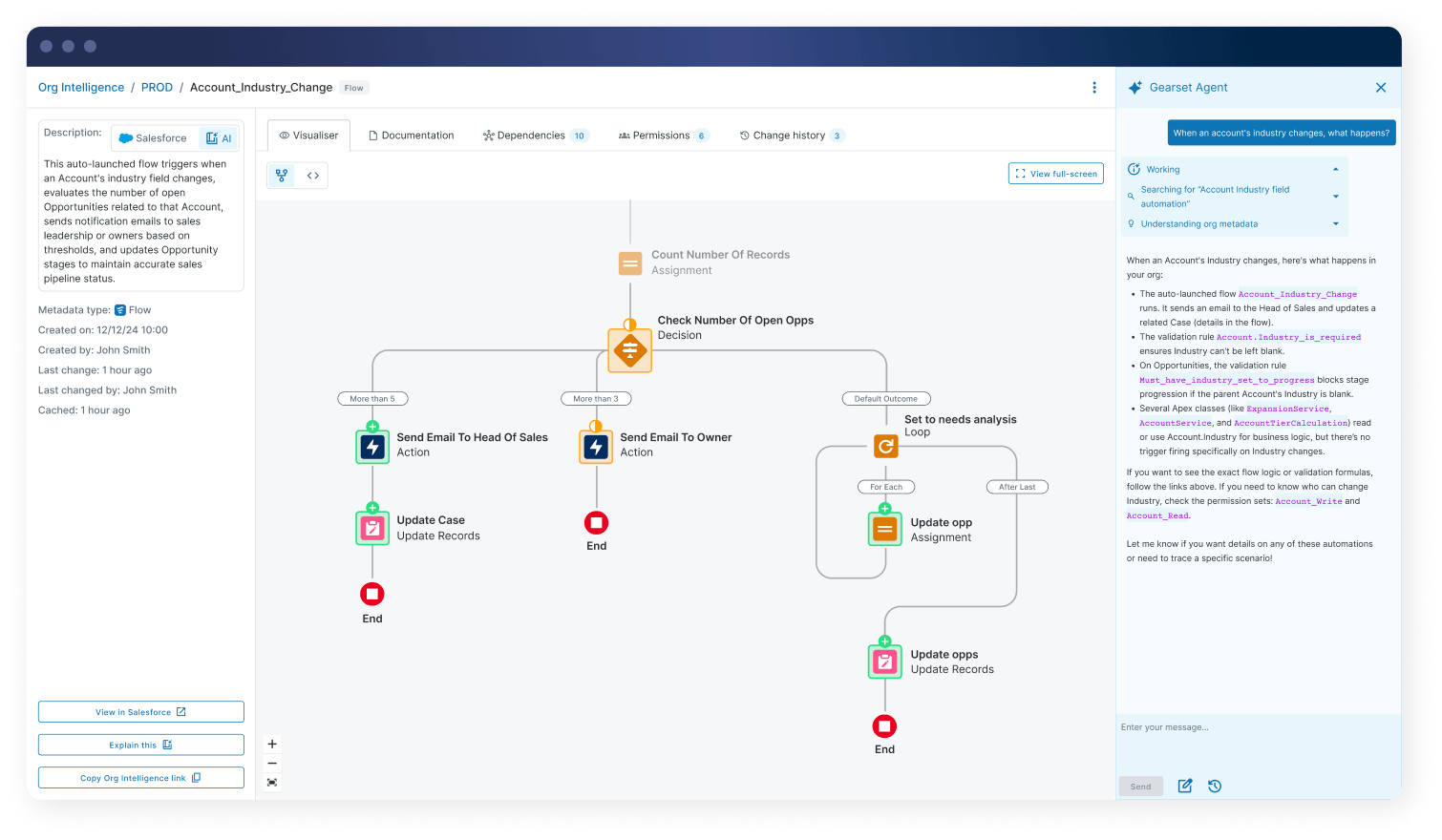
The next Job To Be Done then emerged: how can I safely change X to get result Y? What will be impacted if I delete Z? A conversational interface is a natural fit for this problem, and the deterministic solution underneath informs the context of the LLM, generating better results. So we exposed the Gearset Agent in Org Intelligence, armed with that data. The agent performs reliably because it’s grounded in context provided by a deterministic analysis of the org.
Automated Testing
UI testing is powerful, but getting value from it has historically been hard. Many teams struggle to get tests set up in the first place, and those that do often find the maintenance burden unsustainable. Tests break when Salesforce changes, failures pile up, and the suite gradually falls into disrepair until it’s easier to ignore than fix.
This is a whole problem that, in our view, wasn’t the right one to solve until LLMs gave us new capabilities. LLMs changed the equation: they made setup and adoption much easier, made it simpler to import tests from legacy platforms, and easier to self-heal in the presence of changes.
Automated Testing is now in pilot and will be GA in Q1 2026. You click through the expected user journey while Gearset records it and converts it into a test using AI, removing the setup friction that’s held teams back from getting their critical paths under test.
Autonomous Delivery
Looking ahead to Q2, the Gearset Agent will gain the ability to autonomously implement certain changes on your behalf — the small, well-defined tasks that never get prioritized because they’re not worth the context switch. It handles the toilsome work so your team can focus on complex projects without interruption.
From DevOps to delivering change
Our customers know us best for DevOps. But what you’re really looking for is more change per unit effort: greater organizational agility. DevOps is one part of that solution. To make change to production, you have to be able to repeatably and reliably deliver those changes — it’s non-negotiable. But it’s only one part.
When Gearset started, most teams building on Salesforce were losing time to manual comparisons and deployment processes. As teams adopted Gearset, our solution gave them that time back for higher-leverage work. LLMs have created this scenario again. There’s a new class of tasks that consume a lot of energy, but suddenly no longer deserve the time you spend on them.
So we’re expanding. DevOps remains fundamental, but we’re building beyond it. LLMs excel at ambiguity and interpretation; deterministic systems excel at precision and predictability. Real workflows need both, so we’re combining them, using each where it’s genuinely stronger. And we’re moving fast — every quarter brings new capabilities.
You won’t find copycat AI features in Gearset. You’ll find solutions to problems that actually hold back your agility, built with the same discipline and customer focus that’s defined Gearset from the beginning.
To see an example in action, explore Org Intelligence and discover how AI performs when it’s grounded in real expertise. And if you haven’t already, sign up to our newsletter to hear about new releases first.