
Agentforce Vibes is Salesforce’s proprietary AI coding platform, letting you go from idea to deployable Salesforce code in minutes — all through a few simple, conversational prompts.
It’s a compelling proposition, and it’s already changing how developers and admins build on the Salesforce platform. But faster code generation brings with it a challenge that can’t be overlooked: your delivery process wasn’t built for high volumes of change. The review practices, quality standards, and governance controls that protect your org were designed around deliberate, human-authored changes. When an AI agent can produce and deploy an Apex trigger in the time it used to take to open a new file, those safeguards can fall behind quickly and production incidents creep in.
This post breaks down what Agentforce Vibes is, what it means for Salesforce teams, and why governance practices like structured code reviews, automated testing, and observability become more important when vibe coding enters your delivery process.
What is Agentforce Vibes?
Agentforce Vibes is Salesforce’s AI coding assistant that’s available as a web-based IDE or a VS Code extension, and is part of the wider Agentforce platform. Its vibe coding agent, Vibe Codey, enables developers to describe a feature in natural language and the coding agent will generate the code to build it.
Agentforce Vibes can be used to:
- Generate Apex classes, triggers, and tests
- Build Lightning Web Components and UI elements
- Create Agentforce agents
- Debug, refactor, and optimize existing code
Connecting directly to your Salesforce org, it draws on your existing metadata and codebase to inform what it generates — helping to keep new development consistent with your existing code. It’s designed to accelerate Salesforce development with more autonomous steps and less human input, which makes governance and oversight especially important.
Salesforce DevOps in the age of AI: is your custom pipeline ready?
From low-code to AI-prompted Salesforce development
The Salesforce platform has always leaned toward low-code and no-code. Most customization happens through a visual interface and declarative configuration, with Apex and Lightning Web Components reserved for more complex logic. Although Salesforce is designed to be accessible and easily configurable, writing and deploying changes still demands technical knowledge, careful review, and a clear understanding of how each change fits into the wider org.
Agentforce Vibes takes the simplicity of the Salesforce platform a step further. Instead of constructing changes manually, you describe what you want: “Create a Flow that assigns leads to the nearest available rep based on territory” or “Refactor this Apex class to improve test coverage.” Vibe Codey then translates the prompt into code. Your role shifts from author to reviewer: guiding, refining, and validating rather than building from scratch.
Benefits of vibe coding for Salesforce teams
Originally a term known only to niche developer circles, vibe coding has surged into the mainstream. Its significant impact on software development even led to it being named ‘Word of the Year’ by Collins Dictionary in 2025. Here’s why it’s taken the spotlight:
-
Speed. Vibe coding is capable of accelerating development from ideation to build, which is particularly helpful for teams with a backlog of org improvements.
-
Accessibility. As it uses conversational prompts, vibe coding breaks down technical barriers to entry. This means developers, admins and business analysts with limited deep coding and programming knowledge can become more actively involved in Salesforce code changes, helping to deliver a higher volume of updates more rapidly without needing to increase headcount.
-
Developer productivity. Vibe coding can take care of those simple, routine, boilerplate tasks that take up a lot of valuable time, meaning you can reprioritize your team’s skillset to projects that deliver higher value or are more complex, such as strategic architecture, logic or system design.
-
Salesforce integration. Vibe coding through Agentforce Vibes integrates with your org’s metadata automatically, so the AI agent knows your objects, fields and existing code. It also understands Salesforce schema and is less likely to get tripped up by some of the platform’s idiosyncrasies.
Agentforce Vibes is designed to accelerate developer productivity — letting teams build faster and offload repetitive coding work to AI, within the context of your Salesforce org.
Considerations and limitations of Agentforce Vibes
Vibe coding isn’t a replacement for engineering judgment. There are a few key considerations Salesforce teams should keep in mind if adopting Agentforce Vibes:
-
Tech debt can increase. When Vibe Codey writes an Apex trigger or generates a Flow, someone on the team needs to be able to read it, understand it, and own it. The rapid introduction of AI-generated code significantly increases risk, if your team don’t understand the changes being made — from production incidents and costly downtime, to long-term technical debt.
-
Usage limits restrict scalability. Each Salesforce org has a daily quota of premium requests, with additional usage handled by a lower-capacity fallback model. These limits can be consumed quickly by complex tasks, meaning teams need to prioritise how and when they rely on the tool.
-
Contextual awareness isn’t foolproof. While Agentforce Vibes has awareness of your org, it can still misinterpret dependencies, conflict with existing automation, or suggest outdated APIs. It may generate code that passes initial checks but fails at runtime, or references fields and logic that don’t exist. These inaccuracies and hallucinations introduce real risk if not properly reviewed.
-
Rigorous testing is a must. Even when code is generated quickly, it still needs to go through proper testing, validation, and deployment processes. AI can accelerate development, but it doesn’t replace the need for quality assurance.
The importance of governance for AI-generated code
Agentforce Vibes is a powerful tool, but with the rapid take-up of AI-generated code comes several risks and challenges.
The biggest problem is that it generates a lot of code, very quickly, in a way that can easily outpace the review processes your team has built around slower, more deliberate development. This means vulnerabilities can easily be introduced and could go unnoticed until release day — or worse, once it’s already in production. Governance becomes the bottleneck as soon as generation outpaces review.
And if your team already struggles to get visibility into your org’s metadata and dependencies, adding AI-generated code only compounds the problem. Agentforce Vibes can produce in minutes what would take a developer days, flooding an already complex org with new code, new dependencies, and new potential failure points. Ensuring deep system visibility through DevOps best practices and automated governance is the foundation you need before AI can safely add to your org at speed.
What about the Salesforce Trust Layer for governance?
Agentforce Vibes is covered by the Salesforce Trust Layer, which governs what happens when the extension sends prompts to an underlying LLM. The Trust Layer ensures that nothing sent to the model is retained or used for training — given that Agentforce Vibes is restricted to sandbox environments, what’s in transit is largely code context and metadata rather than live customer data. That’s an important security control but it’s not a governance framework.
AI-generated code is still code: it can introduce bugs, break integrations, create security vulnerabilities, and conflict with existing automations. The Trust Layer has no mechanism to prevent this, such as enforcing code quality, testing requirements, or peer review processes that keep production stable. And Salesforce restricting Agentforce Vibes to sandboxes confirms that AI-generated code does need to be validated before it goes anywhere near a production org.
This is why DevOps and a robust governance framework are vital for teams looking to adopt AI-supported coding. Teams that can adopt Agentforce Vibes responsibly are those with a CI/CD pipeline that already has automated testing, static code analysis, and code review built-in. That is what makes it safe to move at the speed vibe coding enables. Without it, you’re not moving faster. You’re just accumulating risk you won’t see until it’s already in production.
How Gearset helps you govern AI-generated Salesforce code
Gearset is purpose-built for Salesforce delivery and designed to handle the governance challenges of AI-generated code.
Automated quality checks to handle volume
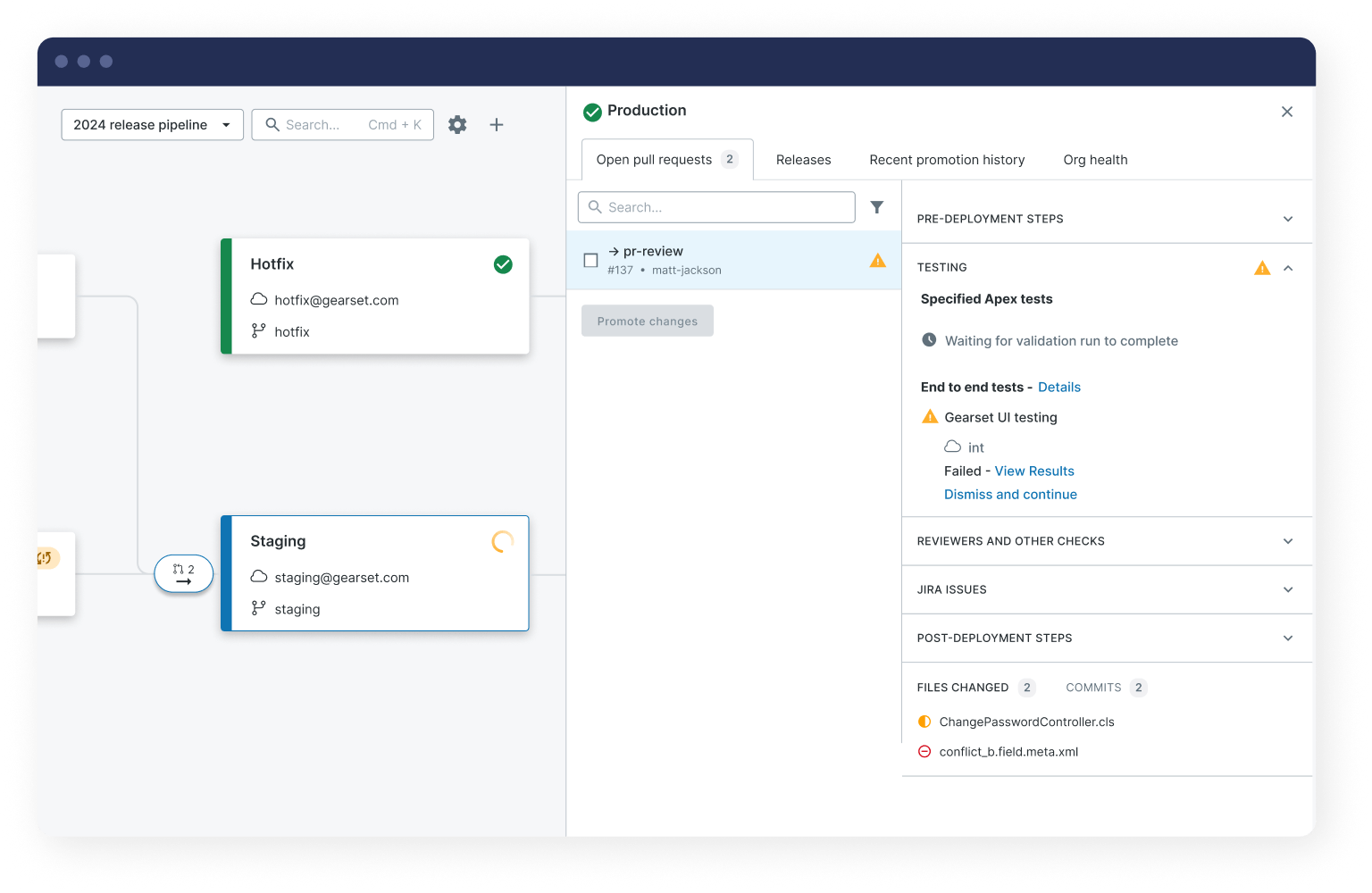
As your team builds, governance can’t rely on individuals remembering to follow process. With Gearset’s automated CI/CD pipelines, AI-generated code moves through the same build, test, and review stages as anything your team writes by hand.
Code Reviews is built directly into that workflow, enforcing automated quality gates consistently, and any code that doesn’t pass is blocked before it can cause problems downstream. Unlike generic code analysis tools or asking an AI to check its own output, Gearset’s code review is Salesforce-native. It understands your org’s metadata, existing code, and configuration — as well as the specific quirks of the platform.
When AI is generating code at volume, manual UI testing doesn’t scale. Run UI tests automatically after every change to check that real user journeys still work — and block Apex deployments on unit test failures, so broken code can’t advance before it’s fixed.
Proactively monitor production performance
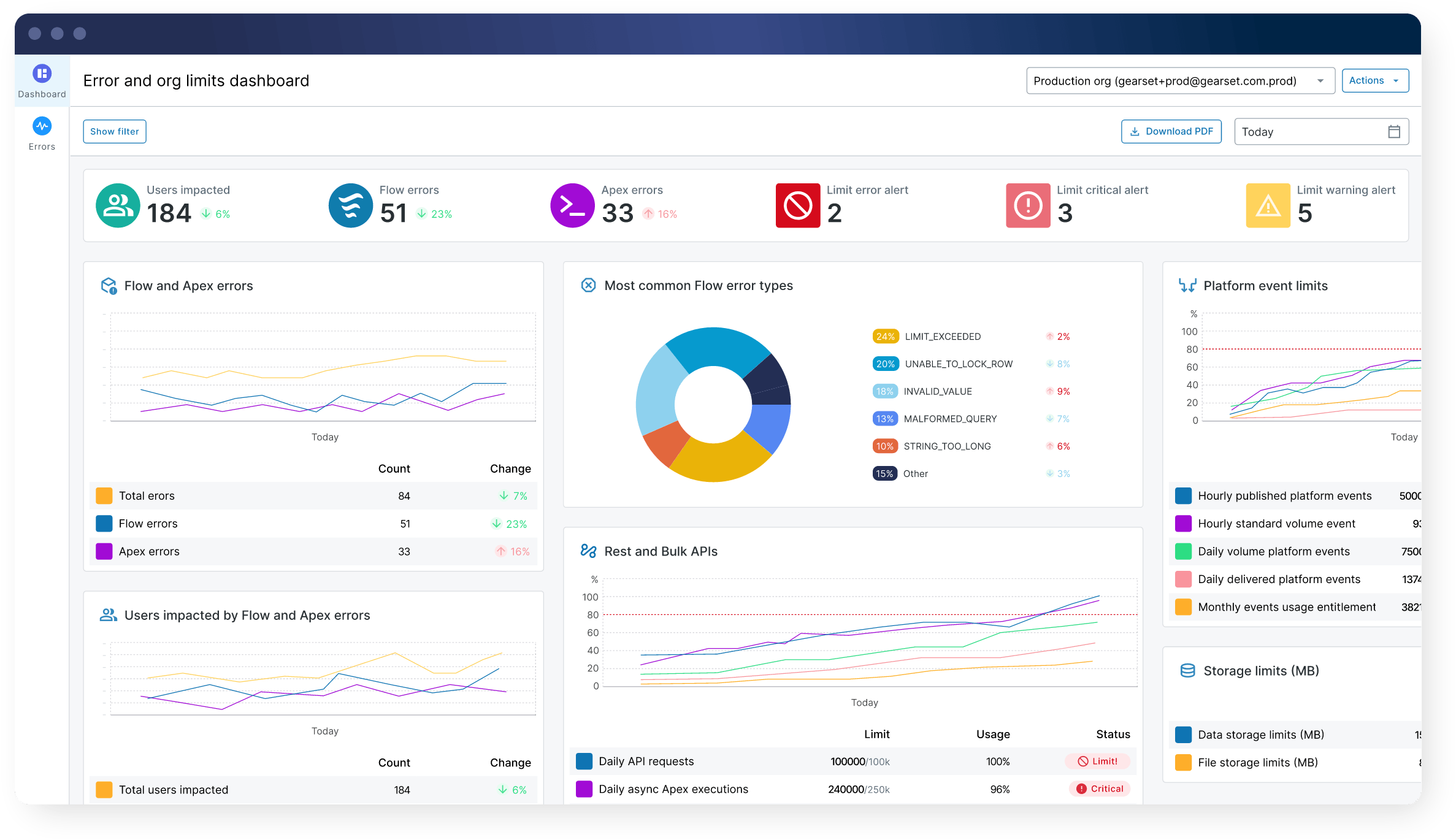
Even deployable code can behave unexpectedly in production. Gearset’s observability tooling provides real-time visibility into Flow and Apex errors, org limits, and runtime issues as they happen, so you can catch problems early and link them back to specific deployments. And if something does go wrong, backup and restore lets you quickly roll back to a known good state with ease.
Move quickly and safely with Agentforce Vibes
The teams that get the most out of Agentforce Vibes will be those that use it to accelerate delivery while maintaining strong review, testing, and governance processes. Gearset enables both — helping you move faster without compromising stability, security, or auditability.
Catch up on our Scale AI Safely webinar to see how leading Salesforce teams are adopting AI responsibly, or speak to one of our DevOps experts for a tailored demo to see how Gearset can help you vibe code safely.