For years, writing code was the constraint. Now, with AI agents generating code faster than ever, governance becomes the bottleneck.
When one developer with a well-crafted prompt can generate more changes in an afternoon than a team could ship in a sprint, the question of how those changes get reviewed, validated, and governed on the path to production becomes the focus. The gap between what AI can generate and what your existing governance can handle is where technical debt, production incidents, and audit failures tend to live.
This post is about closing that gap — not by slowing down AI adoption, but by making sure your DevOps foundations across the full lifecycle are solid enough to handle higher throughput from AI-generated code.
The shifting AI confidence across Salesforce teams
The conversation around AI in Salesforce has moved fast. Twelve months ago, the big question was “how should we be using this?”. Today, most teams have moved past that. Data from our State of Salesforce DevOps 2026 report shows that lack of a clear use case — a significant barrier in last year’s report — is declining as a concern. Teams now know what they want from AI. 82% of Salesforce teams trust AI to write code in the build stage, making it the area of highest appetite across the entire delivery lifecycle. The challenge is building the frameworks to act on that confidently.
The report also showed that security and compliance remain the biggest barriers to broader AI adoption, followed by data quality and budget. This highlights the challenge teams are facing: how do you maintain the governance and auditability your org needs when the volume and velocity of change is increasing? As a result, the majority of the Salesforce community sit somewhere in the middle when it comes to AI confidence: cautiously optimistic, actively experimenting, but not yet ready to hand the keys to an agent.
The good news is that the work required to close the governance gap is the same work that unlocks more ambitious AI adoption. The key is getting your DevOps foundations right. The teams making the most progress share one thing in common: they all have tools and process in place across every stage of the DevOps lifecycle.
Discover the key insights for DevOps performance
The State of Salesforce DevOps
How AI development is changing Salesforce
Tools like Agentforce Vibes, Claude and ChatGPT let Salesforce teams go from idea to deployable code in minutes. But faster code generation changes the risk profile — and in ways that aren’t always obvious until something goes wrong in production.
The most immediate change is volume. Code can now be generated faster than ever, which is a real efficiency gain. It also means a significant increase in the number of changes flowing through your pipeline. And as each change needs reviewing, testing and validating before it reaches production, existing manual checks and approval processes that worked fine at human development speeds get quickly overwhelmed.
Another change is the nature of authorship and accountability. When a developer writes code, they understand and are accountable for what they’ve written. With AI-generated code, someone still needs to review it. But if that review falls to a developer working at human speed, the efficiency gain from AI generation disappears. You’ve just moved the bottleneck, not removed it. The only way to capture the full speed benefit of AI-assisted development is to make sure the review process itself is automated and built into the pipeline — so governance keeps pace with generation rather than becoming the new constraint.
Why stronger governance leads to better AI outcomes
The role of governance in the AI era has shifted. While governance has always been non-negotiable, it’s now actually becoming an advantage. AI-powered development needs the same governance guardrails that development has always needed: visibility, quality gates, fast feedback loops, and the ability to recover quickly when something goes wrong. All these are found in a mature DevOps process, and AI is simply forcing the issue. Without strong DevOps foundations, AI will only create more problems and give you less visibility into what’s happening in your org.
The build phase has always been the longest in the Salesforce delivery cycle, and our 2026 report confirms it still consumes up to 50% of team time. AI can dramatically shorten this phase, but without automation in your delivery process to ensure quality, consistency and security, all you’ve done is move the bottleneck. The teams that invest in automating the validate stage are the ones that will get the most out of the AI speed gains.
So it’s important to assess whether your current tools and processes are set up for AI development across the whole DevOps lifecycle. That’s what will give you the confidence that your org is visible and all changes are governed and auditable, letting you move quickly without losing control.
What robust governance looks like in practice with Gearset
Knowing governance matters is one thing. Knowing what it actually looks like when AI is generating code at volume is another. The good news is that the framework isn’t new — it’s the DevOps lifecycle, just applied to handle upscaled development. And Gearset’s complete end-to-end DevOps platform is built to support the governance challenges that AI-generated code introduces at every stage.
Start with visibility
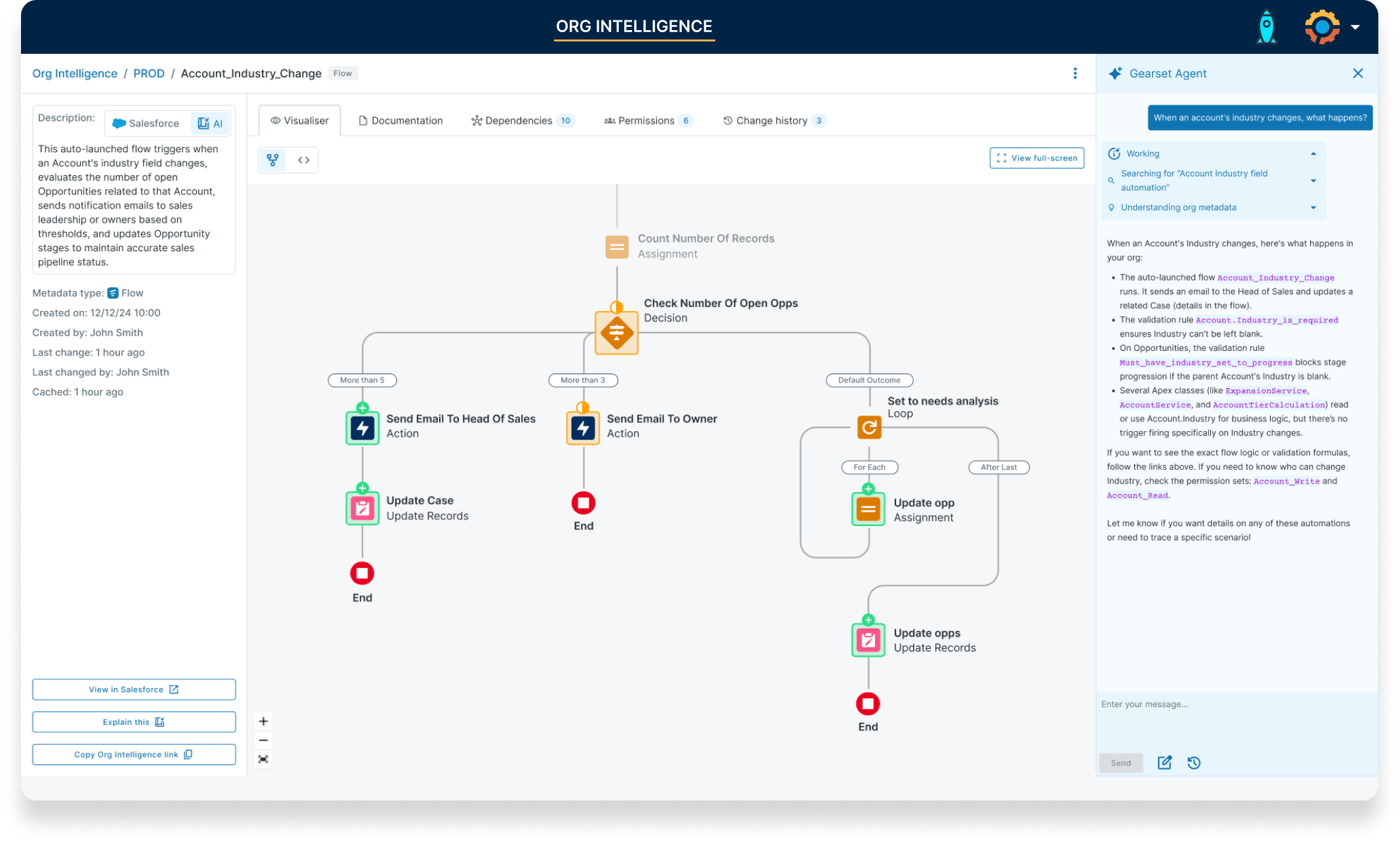
Before generating a single line of AI-assisted code, you need a clear picture of the context of your Salesforce org. If your team struggles to get visibility into your org’s metadata and dependencies — relying more on tacit knowledge — getting that context is a prerequisite for getting valuable results from AI-generated changes. Otherwise, every new class, trigger, and Flow that AI creates might look brilliant in isolation, but may not even be deployable to your org — let alone perform as needed.
Org intelligence gives you that visibility — surfacing what exists, how components connect, and what any new change is likely to affect. That context is what separates confident AI-assisted development from flying blind.
Shift left with automated quality gates
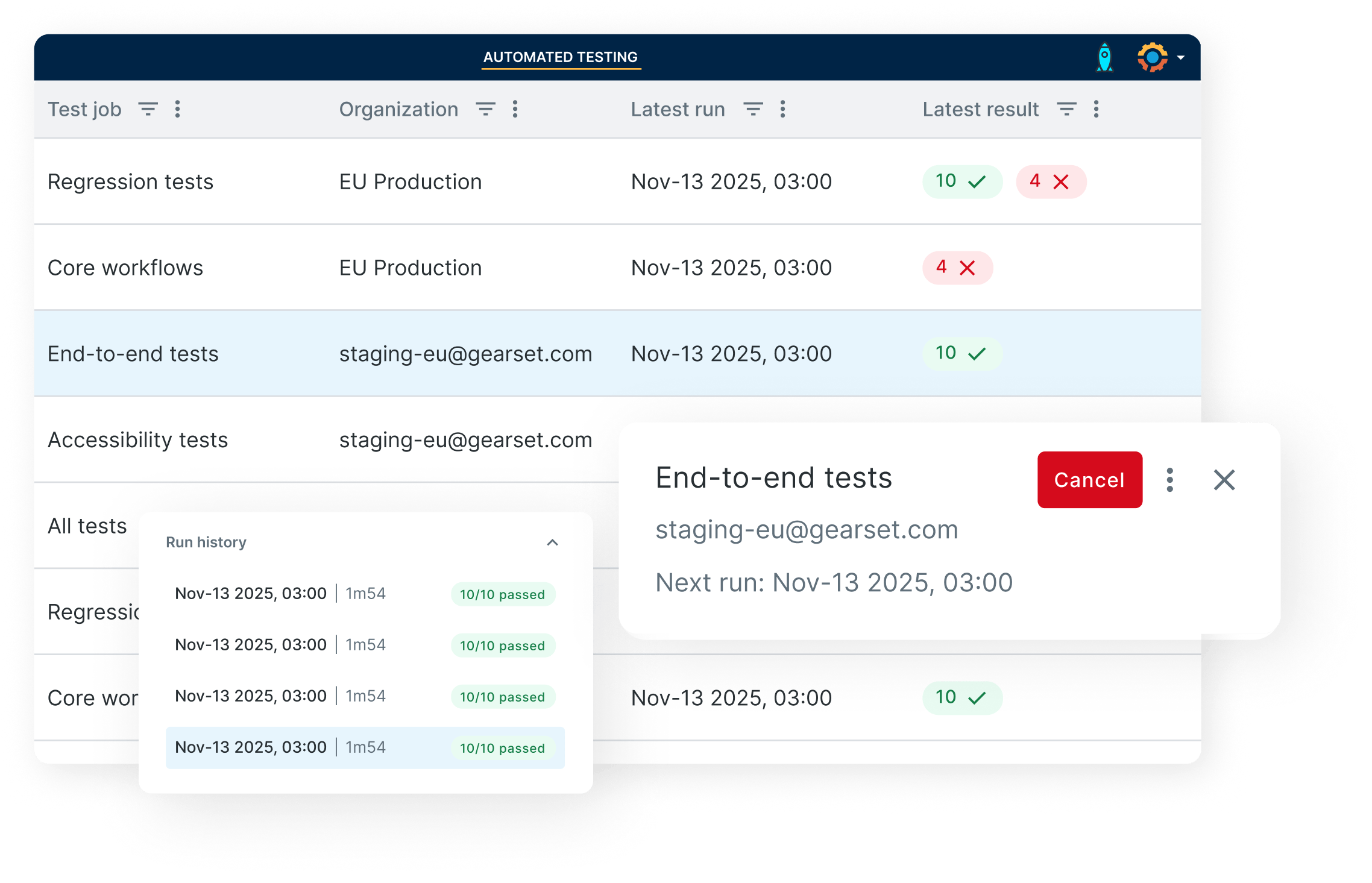
Once your team is building, robust governance can’t rely on individuals remembering to follow due process — especially when the volume of changes is increasing. AI-generated code needs to flow through the same quality gates as anything your team writes by hand.
That means automated pipelines with quality gates that block failing code from progressing. It means automated code review tooling that understands your org’s metadata and existing code, not just running generic static analysis — with approval gates that enforce the standard consistently, every time. And it means two layers of automated testing: unit tests that ensure Apex classes execute as intended, and UI testing that confirms critical user journeys still work as expected after any change.
By shifting left during development, you can catch problems earlier when they’re cheaper to fix, which is vital when AI is generating changes at speed.
Monitor what happens after you deploy
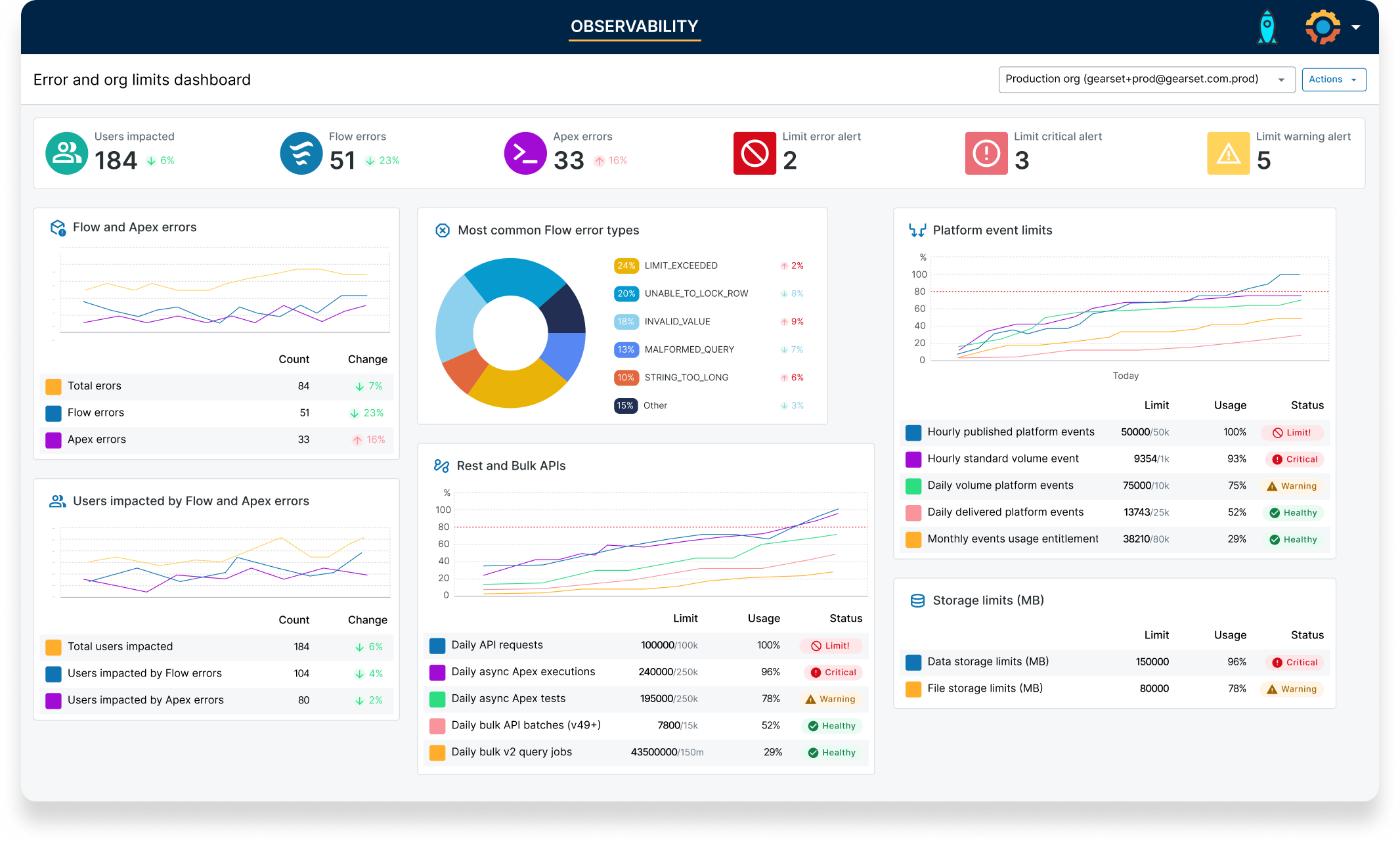
Even well-reviewed code can behave unexpectedly in production, and once-functional code can begin to fail due to breaking changes. That risk increases when you’re shipping faster than ever. Observability tooling lets you identify and triage the most important Flow and Apex errors, org limit warnings, and runtime issues proactively — before users report them — and map them to a specific deployment so you can roll back or fix forward.
And if something goes seriously wrong, backup and restore means you can roll back to a previous state quickly, without the scramble.
For teams deploying AI-generated code at volume, having complete coverage at all points of the DevOps lifecycle is what makes faster development sustainable.
Ready to govern AI development with confidence?
Faster development is only an advantage if your governance can keep up. Start a free 30-day trial to see how Gearset helps Salesforce teams ship AI-generated code with confidence — or book a demo if you’d like a guided walkthrough with our DevOps team.