

"The only additional software you truly NEED for Salesforce."
Gearset vs PMD
PMD only scans Apex, and layering AI tools on top can’t replace org-level context. Gearset Code Reviews gives you deterministic, Salesforce-aware checks across your whole org, every time.
“Deployments and code quality used to be a major topic in every project. Now? It’s barely a topic of conversation. Thanks to Gearset, deployments just happen.”
Unit Lead, Digitall


10,131
93.7%
$625K
$202K
300+
98%
00:02:17
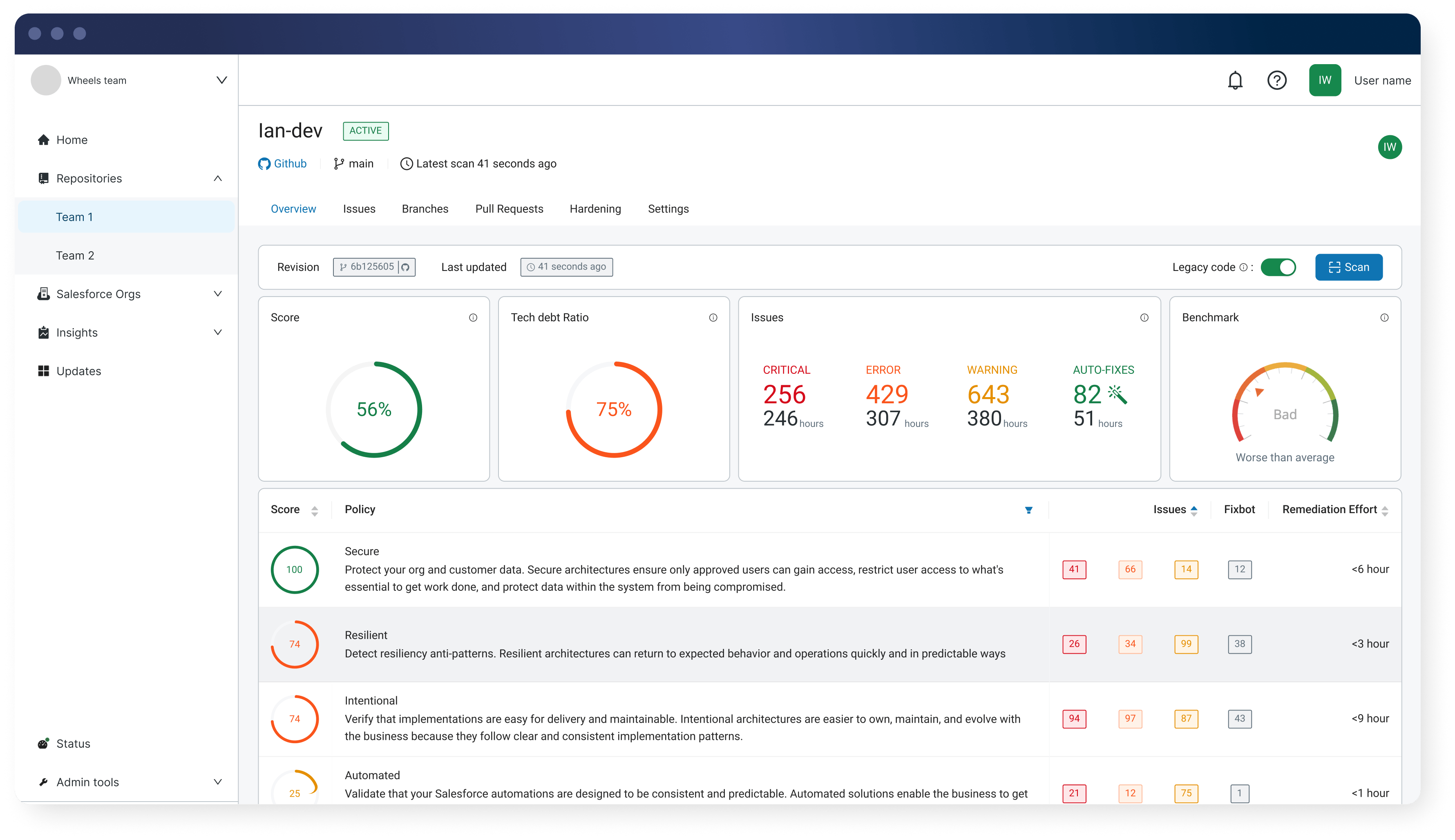
PMD is a generic open-source linter bolted onto Salesforce. Gearset Code Reviews is purpose-built for the platform, giving you org-aware analysis, automated fixes, and deterministic guardrails that hold AI-generated code to account.

PMD covers Apex and Visualforce. Gearset Code Reviews scans 300+ metadata types — Flows, LWC, Agentforce, profiles, and config — catching the issues PMD can’t see.
Gearset applies standards-based rules on every PR, without the hallucinations or inconsistent results that AI review tooling can introduce.
PMD’s false positive rate reaches 60%, filling reviews with noise. Gearset’s org-aware analysis keeps false positives under 1% — so reviewers focus on real risks.
Code Reviews doesn’t just flag problems — it generates pull requests with fixes automatically. Developers spend less time on rework and more time shipping quality changes.
Start enforcing quality gates on day one without clearing years of existing tech debt. Protection Mode blocks new violations only, so you can focus on what matters first.
PMD’s Salesforce ruleset is community-maintained and slow to evolve. Gearset refreshes rules with every release, keeping you aligned with Salesforce’s latest guidance.
“When you have almost 30 people pushing changes and only 2 to 3 people reviewing, they need as much help as they can get. Code Reviews has sped up our review process immensely, by flagging issues straight off the bat and helping us fix them.” — Ergon
As Deliveroo keeps smashing growth targets month after month, Code Reviews is a key asset to enable us to leverage Salesforce technology, ensuring a robust and secure solution at scale.
Director of Information Systems, Deliveroo
You don’t always catch everything when you’re reviewing by eye. Now we’ve got a second set of eyes on every pull request — and it’s looking for exactly the right things.
Salesforce Applications Engineer IV, HackerOne

In the past we saw a lot of issues that we can now easily solve with Code Reviews — like missing entry criteria and fault paths in flows. You can easily miss these in an implementation project because it needs to be finished quickly.
Senior Consultant, DIGITALL
Here’s what you should look for in a Salesforce code review solution — and how Gearset delivers:
Gearset is ISO 27001 certified and offers you enterprise-grade security. Your Salesforce data and metadata are encrypted in transit and at rest, hosted on the same AWS data centers trusted by Salesforce, with 24/7 intrusion detection. These security foundations support compliance requirements across regions and give teams of all sizes the freedom to move fast and innovate with confidence.



The core question is whether you need a development tool or a governance layer. PMD is a free, open-source static analyzer that flags issues in Apex and Visualforce. It works well as a lightweight linter for individual developers, but it was built as a generic cross-language tool, not for the complexity of a modern Salesforce org.
Gearset Code Reviews is purpose-built for Salesforce. It scans 300+ metadata types across Apex, Flows, LWC, Agentforce, profiles, and configuration, understands how your components interact, and surfaces findings with the context developers need to act. It integrates directly into your CI/CD pipeline and applies quality gates automatically on every pull request.
If your team runs lean with a small codebase and simple requirements, PMD can provide a basic level of scanning at no cost. But if you’re managing multiple contributors, introducing AI-generated code, or need consistent enforcement across teams, PMD’s limited coverage and high false positive rate become real bottlenecks. Gearset closes those gaps without adding toolchain complexity.
PMD applies generic rules that were originally designed for languages like Java and adapted for Apex. Because it has no understanding of your org’s structure — how components relate, what metadata types are present, or how Flows interact with code — PMD can’t distinguish between a genuine issue and a pattern that’s perfectly valid in context.
Gearset’s org-aware analysis understands Salesforce’s architecture. It scans the full picture, not just individual files, so findings reflect real risks rather than pattern-matching noise. Across Gearset’s customer base, the false positive rate stays under 1%, compared to rates of 60% or higher commonly reported with PMD.
PMD’s Salesforce support covers Apex and Visualforce. It has no meaningful coverage of Flows, Lightning Web Components, Agentforce metadata, profiles, or the hundreds of other metadata types that make up a modern Salesforce org.
This creates a real blind spot as Salesforce development moves further toward declarative tools. Flows have become central to how teams build and automate processes, but PMD can’t check them. Gearset Code Reviews covers all of it, including Agentforce, so your governance layer keeps pace with how your org actually works.
It’s a pattern we hear about: teams using PMD for Apex scanning and then layering on an AI assistant like GitHub Copilot or Claude to handle the gaps. The thinking makes sense, but in practice it gives you two incomplete layers rather than one reliable one.
PMD still can’t see Flows, LWC, or broader Salesforce metadata. And AI code review tools are non-deterministic, meaning their output is different on different passes. They aren’t trained on the latest Salesforce guidance, and can hallucinate fixes that look right but break things. To reliably govern AI-generated code, you need a deterministic review layer in your process.
Gearset Code Reviews provides a single, deterministic layer that understands Salesforce end to end. The same rules run on every scan, every time. Coverage extends across 300+ metadata types. And because it’s built for Salesforce, not adapted from a generic tool. Findings are accurate, actionable, and aligned with current Salesforce best practice.
PMD has no concept of tech debt separation. When you run it against an existing Salesforce org, it surfaces every violation it finds, including issues from years of previous development. This creates a backlog that can take months to clear before quality gates can be enforced meaningfully. Many teams either ignore the output or abandon the tool.
Gearset’s Protection Mode lets you set a reference date. Any violations introduced before that date are classified as tech debt and excluded from gates. New violations, including those introduced after you start using Code Reviews, are flagged and blocked. This means teams can start enforcing quality standards from day one without first completing a large-scale remediation effort.
Most teams connect Gearset Code Reviews to their version control system and start scanning within minutes. There’s no CLI scripting, local toolchain configuration, or manual webhook setup required. Code Reviews connects directly to GitHub, GitLab, Bitbucket, or Azure DevOps and begins scanning pull requests automatically.
Configuring rules, setting up Protection Mode, and integrating with Gearset Pipelines for automated gating typically takes a few hours rather than days. Compared to integrating and maintaining PMD in a CI/CD pipeline — which usually requires custom scripting, output parsing, and ongoing updates — the difference in setup time is significant.
PMD is open source and free to download. But the total cost of using PMD in a production context includes the time to integrate it into your pipeline, write scripts to parse output, maintain those scripts through Salesforce releases, triage high volumes of false positives, and fill in the gaps PMD can’t cover. For most teams, that ongoing engineering overhead adds up quickly.
Gearset Code Reviews is a paid subscription with per-user pricing. It includes the scanning engine, CI/CD integration, Autofix, Protection Mode, insights dashboards, and access to Gearset’s support team. Teams typically find that the time saved on false positive triage and pipeline maintenance alone offsets the cost, even before accounting for the quality and security improvements.
Yes. Gearset Code Reviews integrates natively with GitHub, GitLab, Azure DevOps, and Bitbucket for pull request scanning. If you’re using Gearset Pipelines, code reviews run automatically as part of every build — no separate job configuration needed.
Gearset also integrates with Jira and Azure DevOps for work item tracking, so findings link back to the changes and stories that introduced them. This gives teams full traceability from requirement to production without switching between tools.
Gearset Code Reviews is part of a complete Salesforce DevOps platform. Code reviews sit alongside deployment, version control, backup, automated testing, and CI/CD pipelines, sharing context across every stage of delivery. Quality governance isn’t bolted on; it’s built into how changes move through your process.
Standalone tools require integration work, separate configuration, and manual coordination with your deployment workflow. With Gearset, findings surface in your pipeline automatically, fixes apply without leaving your workflow, and quality trends are visible alongside your release performance — all in one place.
For teams building a complete DevOps practice, or looking to govern AI-generated code at scale, compare Gearset against other Salesforce code review solutions including SonarQube and Salesforce Code Analyzer.
Get a closer look at Gearset Code Reviews and see how it fits into your CI/CD pipeline.
Arrange a tailored demo with our DevOps experts. Kick off the process with a 15-minute call to discuss your requirements.
Talk to an expert in minutes with a 4.9/5 customer happiness rating.